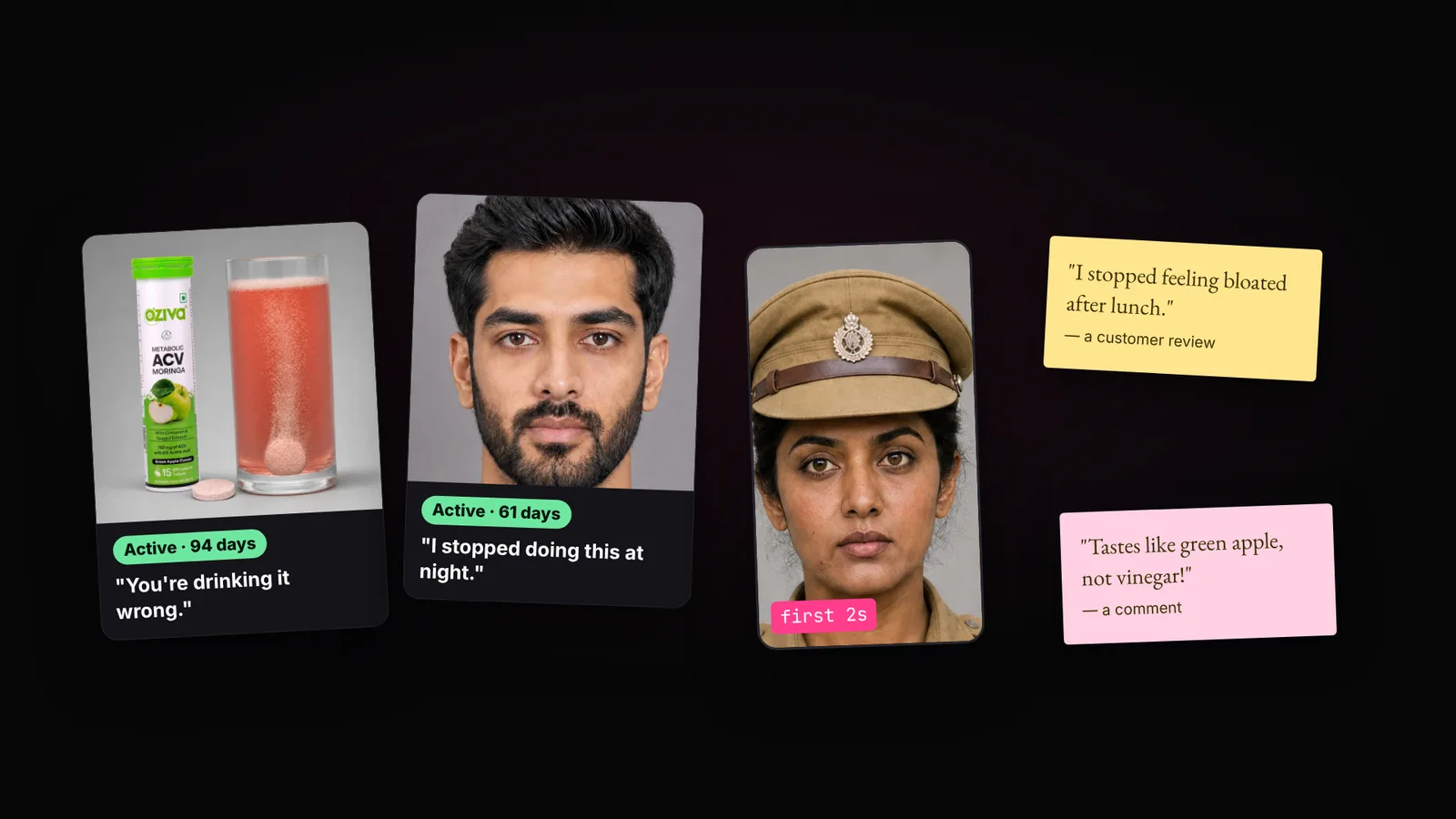
This lesson starts where the last one ended: you already have a concept and a hook, and usually a format to go with them. If you don't yet, find them first. Now you need the full script.
Most people write it as a paragraph, generate the voice, and it comes back rushed. The middle jumps from the problem to the product with no reason in between. You can't see why, because a paragraph hides it.
This lesson is for promo ads for a physical or digital product. Write the script the way we do: format first, length second, and every line in a table where the gaps can't hide. You own the concept and the hook; AI helps you structure and check.
Why you shouldn't skip this step+
1. Finalize the format
The format usually gets decided together with the concept: a confession works as UGC, a myth-buster as an explainer. So lock it before you write a word.
The format decides who speaks, how fast, and what the script has to contain:
| Format | What it is | The script needs |
|---|---|---|
| UGC | A creator talks to their phone about the product | One speaker, casual lines, a light demo |
| Yapper | One person talking fast to camera, opinion-led | A strong take and quick, punchy lines |
| Explainer | A narrator teaches how it works | Calm lines, one step at a time |
| Voiceover | An unseen voice over product shots | Narrator lines plus clear visual cues |
| Storytelling | A mini story with a turn | Characters, a moment of change, dialogue |
| Street interview | A host asks strangers a question | The question plus two or three answers |
| Podcast | Two people at mics, one sharp exchange | Two named speakers, back and forth |
| Animated / claymation | Stylised characters or objects | Short lines; the visuals carry more |
One concept, more than one format? You can test the same concept as, say, UGC and a street interview. Write a separate script for each format, because the length, the pace and the lines all change with it.
2. Find the right length for your niche
There's no universal right length. It depends on the format and on your niche. Find yours from evidence: time your five best-performing past ads and five competitor ads in the same format that have run for 7 days or more. Start at the typical length you find.
If you have nothing to go on yet: UGC for people who don't know you often runs around 30 seconds, for people who do around 20, and explainers 60 to 120.
3. Budget syllables per second, not words
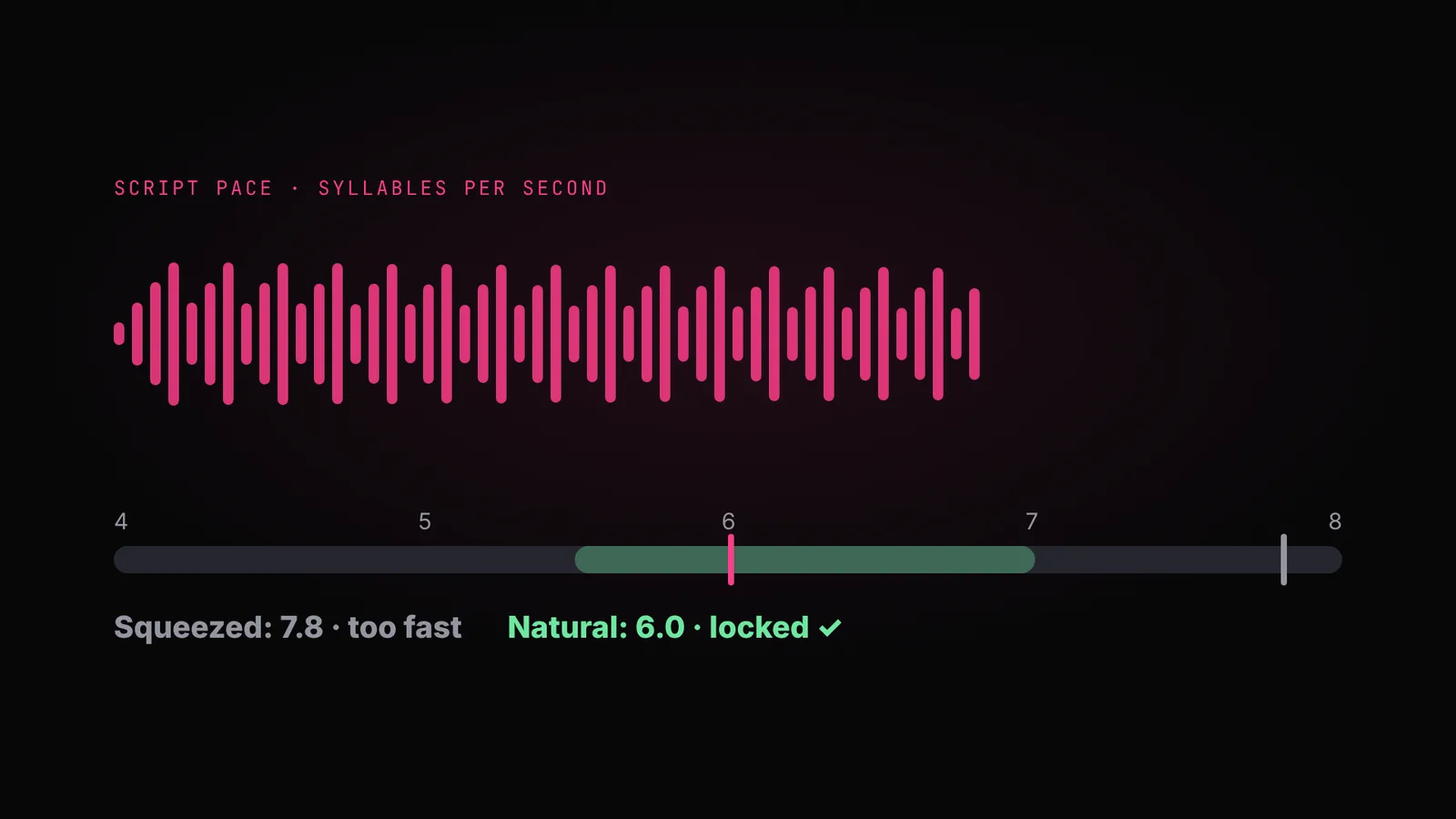
Word counts change with language: the same sentence has a different number of words in Hindi and English. SPS (syllables per second) doesn't lie. Your budget is simple: target SPS × seconds of speech = syllables. Speech should fill about 85% of the ad.
| Format | Target SPS |
|---|---|
| Explainer, voiceover | 4.5 to 5.5 |
| UGC, podcast, street interview | about 6 |
| Yapper, energetic promo | 6.5 to 7 |
| Anything | over 7.5 is too fast |
Language changes it too. Languages pack syllables differently, so the same feel runs at a different rate. Take the number for your format (it's for English), then adjust for your language:
| Language | Compared with English |
|---|---|
| Hindi, Hinglish | about 10% faster |
| French, Italian | about 20% faster |
| Spanish, Japanese | about 30% faster |
| German | about the same |
| Mandarin | about 10% slower |
Example: a 20-second UGC ad has about 17 seconds of speech. At 6 SPS that's about 100 syllables. Over that? Cut lines, never speed up the voice.
Don't worry if SPS sounds technical. You don't count anything. You work on the script; Claude or ChatGPT counts the syllables, checks the SPS and times every line when you use the prompt below.
4. Write every line in a table
You don't build this table by hand. Fill in the prompt below and Claude or ChatGPT returns your script as a table like this, with each line's speaker (and who they're talking to), emotion and pace, job, a clarity check, a light visual cue and its timing, plus a list of gaps and concerns. Here's what the output looks like for a 20-second UGC ad for a fizzy apple cider vinegar tablet:
| Time | Speaker → to · emotion | Line | Job | Visual cue | Syllables @ SPS = sec |
|---|---|---|---|---|---|
| 0.3 | Riya → camera · conspiratorial | "You're drinking your apple cider vinegar wrong." | HOOK | Holds up a glass, one eyebrow up | 12 @ 6.0 = 2.0 |
| 2.7 | Riya → camera · relatable | "You take it at night and still feel bloated after lunch." | SYMPTOM | Hand on stomach | 13 @ 6.0 = 2.2 |
| 5.3 | Riya → camera · weighty ×0.85 | "Because at night, there's nothing for it to work on." | PROBLEM | — | 12 @ 5.1 = 2.4 |
| 8.1 | Riya → camera · thoughtful ×0.9 | "It works best before food, so timing is everything." | BRIDGE | Taps her watch | 13 @ 5.4 = 2.4 |
| 10.9 | Riya → camera · warm ×0.9 | "So now I drop one tablet in water before breakfast." | SOLUTION | Tablet fizzes in the glass | 14 @ 5.4 = 2.6 |
| 13.9 | Riya → camera · pleased | "Two weeks in, no more heavy afternoons." | IMPACT | At her desk, light and busy | 10 @ 6.0 = 1.7 |
| 16.0 | Riya → camera · playful ×1.1 | "And it tastes like green apple, not vinegar." | PAYOFF | Sips, grins | 11 @ 6.6 = 1.7 |
| 18.1 | Riya → camera · upbeat ×1.1 | "Tap the link and get your first week free." | CTA | Points down to the link | 9 @ 6.6 = 1.4 |
The last column prints each line's SPS so you can spot a line that's much faster or slower than the rest. It isn't there to make every line identical: an ad at one steady rate sounds flat. Plan the change in the pace (×0.85 for a weighty line, ×1.1 for an urgent one).
Your job is to read it. The Job column on its own tells the whole ad: HOOK · SYMPTOM · PROBLEM · BRIDGE · SOLUTION · IMPACT · PAYOFF · CTA. If PROBLEM or BRIDGE is missing, the ad jumps, and the gaps list will say so. If a line has no job, cut it.
The table also shows two rules at a glance: numbers and symbols are written as words, and the impact closes on the same thing the ad opened with (the heavy, bloated afternoon).
5. Check the argument: no jumps
Five links carry the argument, and each one has to be a line someone actually says. A viewer won't fill in a link you skipped. They just scroll.
- A symptom isn't a problem. "Bloated after lunch" is a fact. It becomes a problem when a line says what it costs: the heavy afternoon, the lost hours, the money.
- The bridge is the line people cut. It carries no new fact, so it goes first when the script runs long. Without it, the ad jumps from problem to product and sounds like two ads stuck together.
- Close on what you opened on. If the problem was the heavy afternoon, the impact gives the afternoon back.
- Let the feeling land. After the ad's strongest line (a confession, a reveal), give it a pause or a reaction. Selling straight after it makes the moment feel fake.
6. Make it sound like a person
Your viewer hears each line once, at speed, maybe with the sound low. Test every line on a stranger who knows nothing about your product. These fixes come up again and again:
- Read it out loud. Wherever you stumble, the AI voice will too.
- Use contractions (it's, don't) and one idea per sentence. Mix short and long sentences so it doesn't drone.
- Talk to one person the whole way: either the camera, or someone in the scene. Only the last line, the ask, may turn to camera.
- Be specific. "Three hours back every Monday" beats "saves time". Use your customers' own words from your research.
- Cut the first line. It's usually throat-clearing. Then check the second.
- Skip the AI words: unlock, seamless, leverage, game-changer, supercharge, and hedges like "can help". The prompt below flags them.
A script is not a screenplay
| The script | The screenplay |
|---|---|
| What's said: dialogue or voiceover, who says it, the emotion | What's seen: every shot, its length, framing and camera move |
| Only light visual cues ("holds up a glass") | Detailed shots, continuity and the video prompts |
| Written by you, with AI as the editor | Written from the approved script by a screenwriter (or OpenDirector's screenwriter step) |
Lock the script first. Then turn it into a screenplay, and that becomes the prompts for each clip.
Try it now
- Pick your format and write down the length your best ads and your competitors' ads run.
- Write your own rough draft, then paste the prompt below into Claude or ChatGPT with the pink parts filled in. It builds the tables, counts the SPS and lists the gaps.
- Read each version's Job column and gaps list: all five links said out loud, nothing a stranger would trip on.
- Fix the gaps it flags, keep the version you'd stop for, then listen to it.
You are helping me write the full video ad script for my product. I already have the concept, the format and the hook.

Concept: [the angle and story of the ad, from my research]
Hook: [the first line, the one that makes someone stay]
Product: [product, physical or digital, and what it does]
Who it's for: [audience, and what they already know]
The one belief: [the single thing the viewer should walk away believing]
Proof we can show: [facts, demos, results]
Format: [UGC / yapper / explainer / voiceover / storytelling / street interview / podcast / animated] (one format per run; to try the concept in another format, run this again)
Length: [seconds, from my best ads and competitor ads]
Target pace: [SPS for this format and language, e.g. about 6 for English UGC, about 6.6 for Hindi UGC, 4.5 to 5.5 for English explainers]
Language: [English / Hindi / Hinglish]
My rough draft: [paste it]

Write THREE versions. Keep my concept and my hook in all three, and make them differ in structure, not wording: change the framework (problem-solution, before-after-bridge, a mini story), who speaks, the tone, where the turn lands, or what carries the claim (a number, a demo, a person). Label each version with what makes it different and who it will land hardest on.

Write each version as a table with these columns:
Time | Speaker → who they talk to · emotion · pace | Line | Job | Clarity | Visual cue | Syllables @ SPS + pauses = seconds

Rules:
- Jobs come from: HOOK, SYMPTOM, PROBLEM, BRIDGE, SOLUTION, IMPACT, PROOF, PAYOFF, CTA. Every version must have a PROBLEM, a BRIDGE and an IMPACT. Cut any line with no job.
- A symptom isn't a problem. Turn the fact into what it costs the buyer (hours, money, a bad afternoon). The IMPACT closes on the same thing the PROBLEM opened on.
- The hook lands in the first two seconds and opens a question.
- Pace per line: neutral 1.0, warm or landing a point ×0.9, weighty or sheepish ×0.85, shocked ×0.75, urgent ×1.1. Mark pauses as <Pause = 0.4s> and add them to the timing.
- Total syllables fit: target SPS × about 85% of the length. Never pad a line to fill time and never slow the read. If it's short, the ad is shorter.
- Clarity: mark each line ✓ or name its risk (jargon, pronoun with no name, fragment, number with no noun). The test is a stranger hearing it once, at speed. Fix every risk before you hand it over.
- Name every person or thing before using he, she, it or they. At most three named people or things in a 30-second ad.
- Pick one way of talking: to the camera, or to someone in the scene. Only the final CTA line may turn to camera.
- A voiceover narrator is never on screen. Lines said by someone on screen are dialogue, lip-synced. Label every line so the two never mix.
- After the strongest line, give it a pause or a reaction before the product.
- Only claims from "Proof we can show". Nothing else.
- Be specific: quantify and never round ("three hours back every Monday", not "saves time"). Use the customer's own words.
- If the product has a mechanism, explain it with one analogy a 12-year-old can picture: "Think of it less like ___ and more like ___."
- Sound like a person: contractions, one idea per sentence, mixed sentence lengths. Cut the first line if it's throat-clearing, and cut any sentence that repeats the one before it. No AI words (unlock, seamless, leverage, game-changer, supercharge), no hedging (can help, might), no unearned superlatives (revolutionary, ultimate, world-class).
- Numbers and symbols written as words. Letter-by-letter acronyms with hyphens (U-P-I).
- In Hinglish, English words in English, Hindi words in Devanagari.
- No em dashes and no bold in spoken lines; the voice reads them badly.
- Visual cues stay light (one short action). No camera directions.
- End with one CTA: an action verb plus what they get ("Tap the link and get your first week free"). A tagline is not a CTA.

After each table, print:
- the Job column as one line,
- the total syllables, seconds of speech and average SPS, and whether it fits the length,
- GAPS AND CONCERNS: any missing link (no PROBLEM, no BRIDGE, no IMPACT), a symptom left as a problem, jumps between lines, a pronoun with no name before it, jargon a stranger wouldn't get, lines that are too fast or too long, a stretch where every line runs at the same pace, padding, claims not on the proof list, anything that sounds written by AI.
Then recommend one version and say why.
Quick answers
How long should a video ad be?
It depends on the format and your niche. Time your best past ads and competitor ads in the same format that have run for 7+ days, and start there.
Why syllables per second instead of word count?
Word counts change from language to language. Syllables per second measure how fast it's actually spoken.
Does this work for digital products and apps?
Yes. The format, length, pace and line table are the same. Only the demo changes: a screen instead of a pack.
Can AI write my ad script?
Use it to structure, tighten and check. Keep the idea and the hook yours. Human scripts are still much better.
Why does my script sound like AI wrote it?
Usually it's the words (unlock, seamless, game-changer), hedges like "can help", and every sentence the same length. Read it aloud, use contractions, and swap vague claims for specific ones.
What's the difference between a script and a screenplay?
The script is what's said, by whom, with what emotion. The screenplay is every shot, its framing and length, and the video prompts.